ideas
The Gate Never Holds
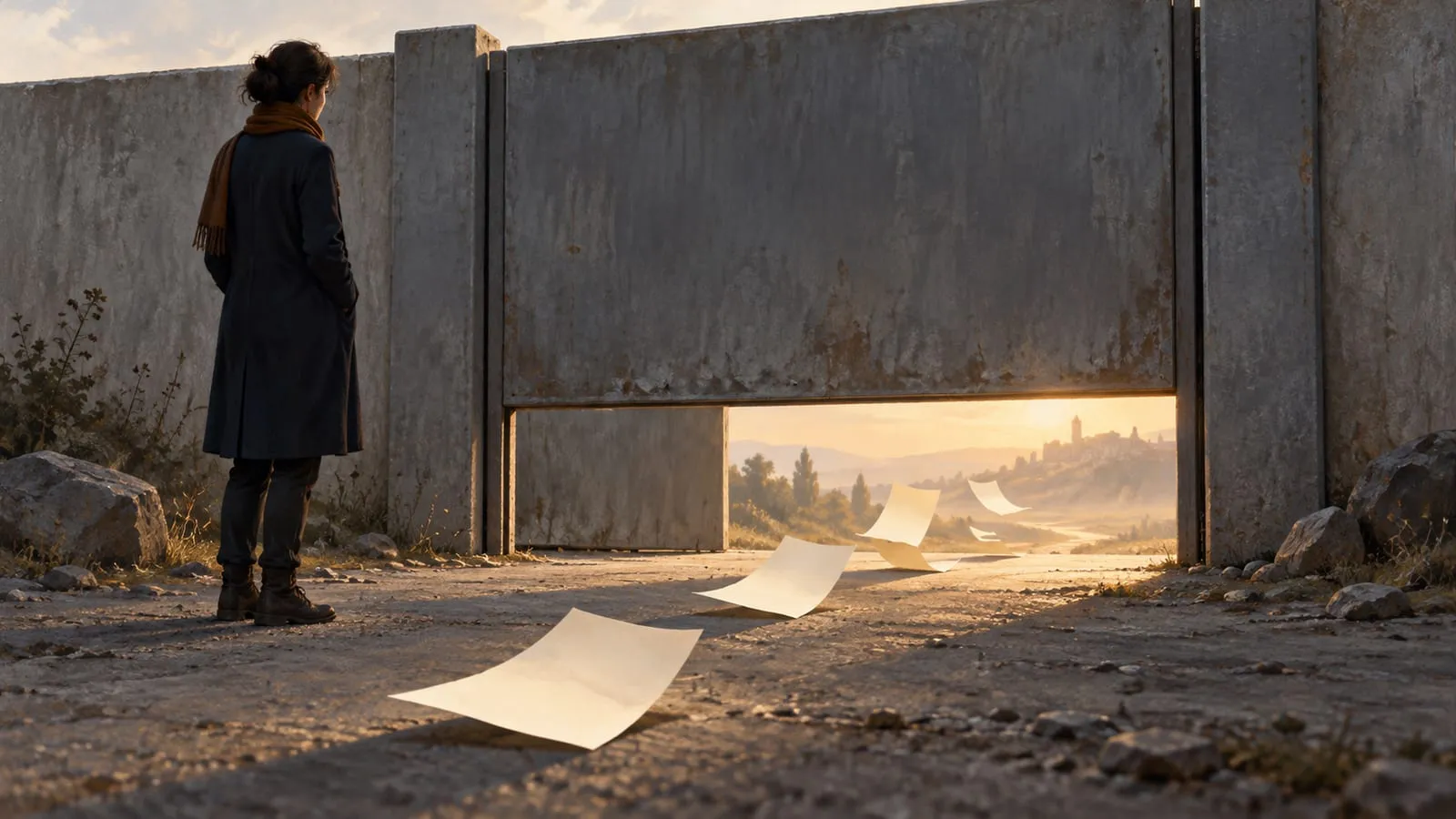
This morning I had promised my eight year old son that he could try it. He had been watching me use Claude Fable 5 last week, asking what it was and what it could do, Is it really great? and I told him that on Saturday morning the two of us would sit down and he could ask it anything he liked. I opened it to keep that promise. It was gone. Overnight, the US government had blocked the access.
Three days ago, Fable 5 was public. On Friday night the government pulled it with an export control order that blocks foreign nationals anywhere in the world. That includes me, building on these models every day from India. It also, it turns out, includes a child in Pune who wanted to ask a computer some questions on a Saturday morning.
The model that got pulled is not a missile. It reads a codebase and fixes the bugs in it. That is what I was doing with it this week, along with a few hundred thousand other people, and then somewhere between Thursday and Friday that became a national security concern.
The model probably is powerful. Governments are probably right to care about who gets their hands on systems like this. But none of that is the part that stayed with me. What stayed with me was how easy the switch was. Someone in Washington decided that a tool I was using from Mumbai should stop working for me. Not because I had done anything. Not because India had done anything that afternoon. Because I happened to be on the wrong side of an access rule.
That is worth sitting with, because it tells you what kind of power this is.
Access is becoming a weapon, and not the kind we are trained to notice. There are no sirens and no tanks. There is a dashboard somewhere, and a row that used to say available now says withdrawn, and the balance shifts a little in someone’s favour. We think of war as a loud thing. Some of the most effective forms of pressure are silent. You do not have to destroy a factory if you can deny it the one machine it cannot run without.
History has done this before. We just filed it under other names.
In 1941 the United States and its allies embargoed oil and scrap steel and froze Japan’s assets. Japan got most of its oil from America, its war machine was being slowly choked, and it chose to strike rather than shrink. Pearl Harbor, then a push south toward the Dutch oil fields. It was not only the embargo, of course. Japan already had its empire and its appetite for more. But the oil cutoff was the thing that turned a long pressure into an urgent one. Denying access is never a neutral act. It only looks clean from the side holding the valve.
There is a closer version of the story, one about knowledge rather than oil. Sometimes a state decides a rival must never be allowed to reach a capability at all, and moves to stop it before it exists. Israel bombed Iraq’s reactor in 1981 and a Syrian site in 2007. The 2003 Iraq war was sold to the world as a way to stop weapons that were not there. Iran’s program has lived for years under sanctions, sabotage, cyberattacks and dead scientists. The cases are different and the moral questions are different, but the logic underneath is the same, and it is very old. Control who knows what. Control who can build what. Control who reaches the future first.
And here is what the people holding the gate keep forgetting. The gate never holds.
China guarded the secret of silk for centuries and made revealing it a capital crime. The secret left anyway. The United States had the atomic bomb to itself for four years before the Soviets tested their own, helped along by a physicist named Klaus Fuchs who simply handed the knowledge across. The Church spent centuries deciding who could read scripture and in which language, until a man with a printing press made that monopoly worthless, after which Europe spent the better part of two centuries fighting over what people did with the books.
Knowledge leaks. Not instantly, and not for free, but it leaks. A gate around it does not hold it in. It buys time, and in that time it opens a gap, and the gap is where the trouble actually lives. One side has the thing, the other knows it is being kept out, so it copies, smuggles, hacks, builds a substitute, and on a bad day it attacks. The gate does not remove the conflict. It usually just stores it for later.
So where does India stand in all this. Honestly, not at the frontier. We have Sarvam, and Sarvam is good, and I want Indian models to become genuinely world class. But we are behind the frontier labs today, by a year or a year and a half, which in this field is both forever and nothing. When a switch gets flipped in Washington, we feel it. That is the uncomfortable part, and pretending otherwise helps no one.
I still do not think the answer is to sit here feeling locked out, because the frontier model was never the whole game. The advantage that lasts is judgment. Knowing what to build, and which problem is real and which one is just a LinkedIn post. Knowing when a model’s output is useful and when it only sounds useful. Knowing what your users in this country actually need, in their languages, inside their particular chaos. None of that is gated. Nobody in Washington can export-control your taste, or your understanding of your own market.
Most people do not fall behind because they are one model back. They fall behind because they wait. They wait for the official launch, the clean API, the better benchmark, the invisible green light from a market that was never going to look their way. There is no green light coming. What is coming is a patchwork: some models available, some not, some restrictions political and some arbitrary, a few of them quietly gone the moment the next release lands.
So build with what you can reach. Use the best tools that will actually run for you, open where it fits, Indian where it fits, American while it lasts, and keep moving when the access changes, because it will. The frontier you cannot touch will always look larger from a distance than it is. The frontier you can touch is where the work is, and the work was always the whole game.